 notes.uart.sh
Case design
The case design is primarily inspired by the New Nintendo 3DS XL:
- I found that the size of the N3DS XL is pretty much perfect for handheld use - I can easily reach the center of the bottom screen with both of my thumbs.
- The entire 3DS line, as well as its predecessors - the DS and GBA SP, has a very satisfying “click” on opening. The 3DS in particular has two snap positions, and an extra “flat” position beyond the second snap; this might have also been the case on the DS Lite, but the SP has only one snap position.
- A part of it is the nostalgia and coolness factor. The 3DS is very satisfying to use, even after all these years; its portable nature and unassuming yet stylish design make it a natural inspiration for a portable computing project like this.
Hinges#
Before even thinking about the case design, dimensions and such, I first focused on what I saw to be the most important part of the case: a hinge to keep both parts of the case clamped together, with specific adjustment points at which the screen would lock with a satisfying click.
Hinges are notably difficult to get right (citation needed); I suspect a 3D-printed design would be prone to breaking easily.
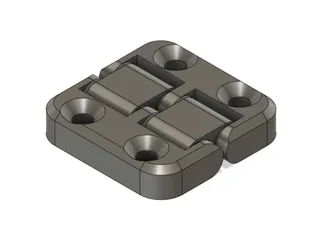
Looking up “3D printed hinge” shows plenty of results… none of which are the kind of hinge I'm looking for. They're all the kind of simple hinge you can find in a hardware store - no stops, doesn't hold anything up, just keeps two parts together.
These make the most sense to 3D print, but they're also so easily purchasable in-person that printing them just doesn't make sense (unless you're a sheltered kid with no courage to go outside on your own but plenty of time and a 3D printer… alas, I'm not that anymore.)
So, what kind of hinge does the 3DS use?
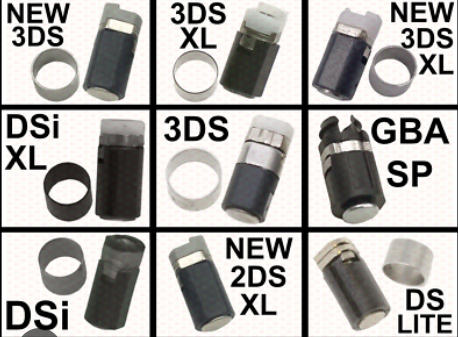
How does the 3DS hinge work? (spoiler: I couldn't find an answer)#
According to the AI search overview, “The Nintendo 3DS uses an internal barrel hinge and detent mechanism combined with a metal axis ring”. Unfortunately, it does not have a source for this claim (what a surprise… /s), but it does give us some keywords to look up.
The word detent in particular came up a lot during my initial searches. From Wikipedia:
A detent is a mechanical or magnetic means to resist or arrest the movement of a mechanical device.
In more palatable terms, a detent is any mechanism that stops a hinge midway through. (Or any moving mechanical thing, really! The pegs on a Wheel of Fortune wheel are also detents, if that Wikipedia article is to be believed.)
There's a million different detent mechanisms, though, so this is not very specific.
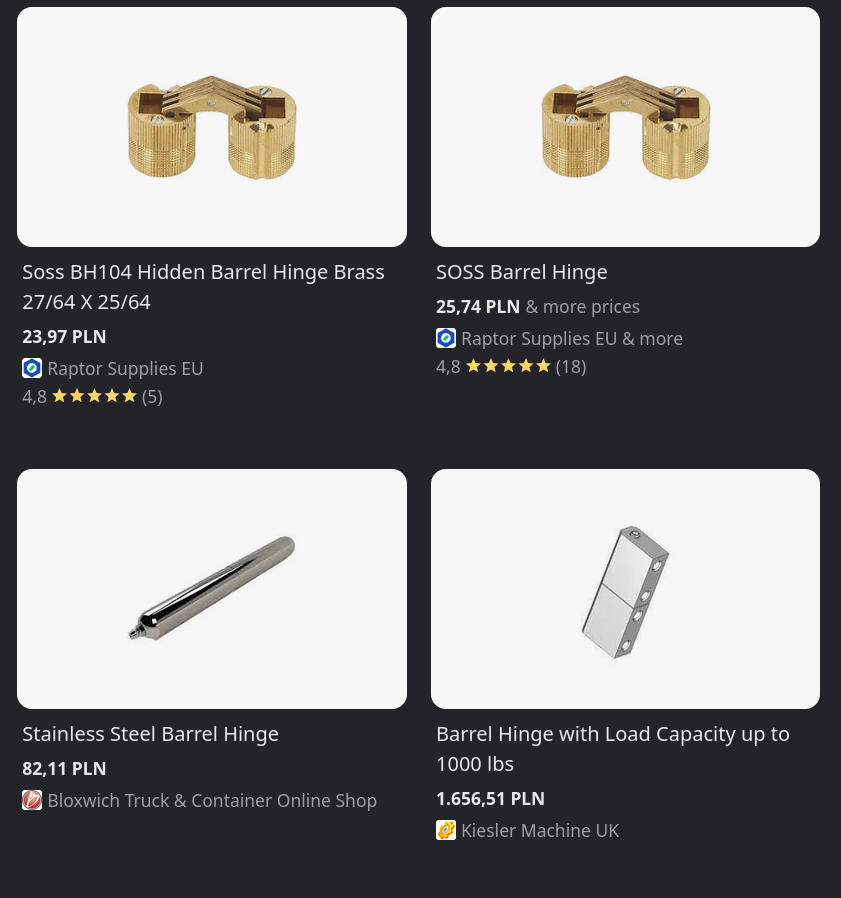
Barrel hinge sounds like it would deliver more promising results… but it doesn't. None of these look even remotely like the 3DS hinge:
I tried looking online to see if anyone had described how the GBA SP, DS or 3DS hinges work internally… but to no avail. Thus, as far as I'm aware, noone's dug into the actual design of these hinges. Perhaps it's obvious to anyone who's worked with mechanical design? Alas, as someone whose entire knowledge of “mechanical design” boils down to “placing some squares in the old XYZMaker”[1], these kinds of things are too far out of my understanding, at least for now.
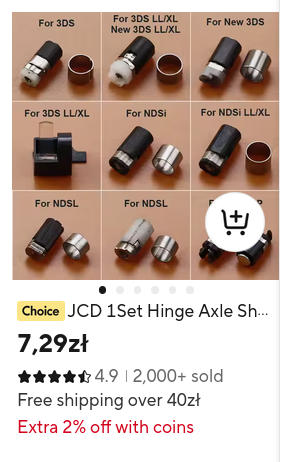
I did, however, discover that replacement hinges are fairly commonly available from sites like AliExpress, and at fairly reasonable prices:
What hinge to choose?#
I tried looking up prior art when it comes to handheld clamshell designs. Two projects caught my attention:
- The DSpi, and its subsequent versions (v2, v3); Raspberry Pi CM5-based DS emulation handhelds. These used GBA SP hinges.
- The Pocket SP, a mod of a Gameboy Pocket into a GBA SP-like form factor. It too uses GBA SP hinges; the author mentions “spending some time investigating alternative ways of making a hinge […]”, but ultimately deciding to use GBA SP hinges instead. (By the way, do yourself a favor and read the blog post under the link - it's an excellent read.)
I also stumbled upon the OpenPandora project, a much older handheld computer; they used their own hinge design, but someone figured out how to mod a DS hinge into it.
Having seen these three projects, I came to the conclusion that the state-of-the-art option for hinges was to… just use the GBA SP hinge.
Or one of the other Nintendo handheld hinges I mentioned above.
See, as far as I could tell from my research, the GBA SP's hinge only has one adjustment point. I think the N3DS XL's two adjustments points are a bit nicer, and would probably work even better in a handheld PC context. The older 3DSes also had two adjustment points, so those would work too. DS? Results inconclusive, hard to see anyone online agreeing on one version of the story.
Using a non-GBA SP hinge would mean that I'd have to manually measure and incorporate it into my design; with a GBA SP hinge, I could just look at how these other projects did it. Oh well - maybe this project needs a bit of a challenge…? (Is this foreshadowing?)
There is one thing that makes working with hinges in this case significantly easier: since the h3 is a case housing an external device (so, not an integrated top half), and the bottom half will connect to the top half over USB, we don't have to keep the cable in the hinge, like the 3DS does (which makes it a pain to take apart…). We can just have the cable routed in some separate way. (How the cable will be routed and what kind of cable we'll use, we'll figure out as we go…).
Top half weight?#
Now that I think about it (and started looking through r/cyberdeck for inspiration), I wonder if the GBA SP hinge (or any of the Nintendo hinges) will actually work here. The main problem is the weight of the top half - since it has to house an entire phone, with its own battery and such, the entire weight is effectively shifted onto the top. A phone is much heavier than a 3DS's top screen - just the weight of the phone alone would probably cause the screen to open flat.
So… what other options do we have?
Hinges, take 2#
Day 2… I started looking up hinge designs again, and stumbled upon some more keywords that actually describe what I need.
In particular, what we need for this project is a friction hinge. Unlike the “flappy” hinges we described earlier, a friction hinge is specifically made to hold its position.
Looking up 3D printed hinges…  has some information about hinges, and some other mechanisms like springs. It's not the best video ever, but it's a good starting point. It primarily focuses on print-in-place mechanisms, though… and doesn't have friction hinges.
(The Polish term, for looking up on Allegro, seems to be zawias cierny. Detent is just blokada, so both combined give zawias cierny z blokadą. That gives various sizes of hinges, but a good amount of them are, in fact, “laptop hinges” and the like, so we're definitely getting closer.)
- ^
XYZMaker was a program for 3D modelling created by XYZPrinting, makers of 3D printers (including my da Vinci Mini w). I specify old XYZMaker specifically because at some point they completely overhauled the software; the newer version was, in my opinion, less intuitive. That was probably a decade ago though…
I know for a fact that XYZPrinting's software was never their strong side, which was a complicating factor given that it was the only software that worked with their printers (no Prusa Slicer or anything of the sort…). The company shut down in 2020, for better or for worse. Maybe for worse, because I don't know how I'll find the NFC-chipped non-standard filament for my printer…